Customer stories

Moriz Walter, Head of Product Development, with a LADS-enabled vacuum pump in the Lab Control Center
© WALDNER Lab Space Solutions
Digitalization in the laboratory – it's on everyone's lips. But there's often a huge gap between PowerPoint presentations and real-world implementation. At analytica 2026 in Munich, WALDNER Lab Space Solutions and VACUUBRAND proved together that it's already working today: across manufacturers and ready for practical use. In the trade show's "Live Lab" special exhibit, both companies demonstrated the seamless integration of a LADS-enabled vacuum pump into the Lab Control Center (LCC) – simple plug & play with no time-consuming setup. We spoke with Moriz Walter about the long-standing partnership, experiences from the trade show, practical benefits, and the future of open standards for laboratories.
Pioneers in laboratory digitalization
Moriz Walter holds a degree in Mechatronics Engineering and has many years of experience in laboratory automation solutions – from benchtop devices to room-filling systems. At WALDNER Lab Space Solutions, he is Head of the Product Development department. His areas of focus include electronics, software, networking, and control technology. Walter played a key role in developing the Lab Control Center (LCC), a manufacturer-independent software platform for digital monitoring of laboratory infrastructure and equipment.
Lab Control Center (LCC)
A manufacturer-independent software platform for centralized monitoring of laboratory equipment. The vision: A digital infrastructure that is just as flexible and universal as WALDNER laboratory furniture – integrated from day one, not as a retrofit solution.
The LCC supports the open standards LADS OPC UA and SiLA, enabling different equipment manufacturers to connect their products. It provides centralized dashboards, alarm management, and automated process documentation, and integrates seamlessly into existing IT environments.
Digitally connected vacuum pumps at analytica
WALDNER and VACUUBRAND have been working together for years. How did the cooperation at analytica come about?
Moriz Walter: Vacuum technology is a central topic in many laboratories and is routinely planned very early as an important part of the infrastructure. We have been physically integrating VACUUBRAND pumps into our furniture for a long time: The vacuum controller is visibly built into the furniture as an operating unit, while the pump works hidden in the base cabinet to save space. Digital integration was then the logical next step.
At analytica, we wanted to demonstrate together that LADS OPC UA represents a true cross-manufacturer standard specifically for laboratory equipment: simply connect via plug & play, with no need to program drivers or invest time and money.
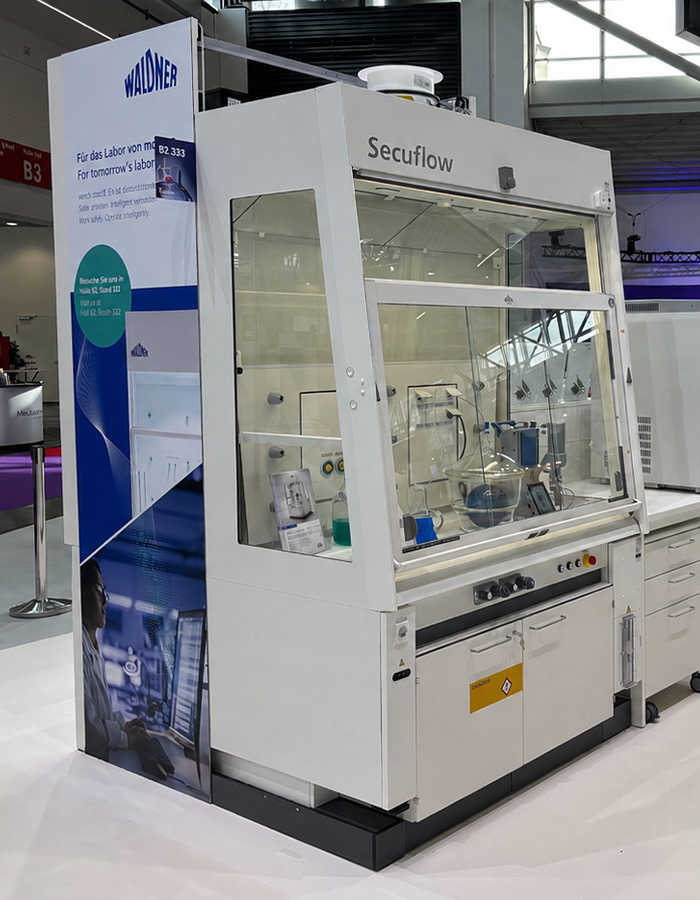
Laboratory fume hood with Lab Control Center (LCC) and digitally integrated vacuum pump at the analytica trade fair
In the "Live Lab" special exhibit, the LADS-enabled vacuum pump was directly integrated into the LCC. What reactions did you receive from visitors?
Moriz Walter: The best moment for me was when a visitor said: "Everyone talks about standard interfaces and easy networking. But here I've seen with standard products from different manufacturers that it really works." That's exactly what we wanted – not just talk about connectivity, but make it a real live experience.
The key moment for many visitors was: Digitalization in the laboratory doesn't have to be complex. They could see directly how the vacuum pump's status is visualized in the LCC and all device information is centrally available. For many visitors, that was a very concrete demonstration, not of the future of the connected laboratory, but of the here and now.
The preparation was also exciting for us: The LCC software and the vacuum pump physically met for the first time on Sunday before the trade show. We plugged them together in the fume hood – and it worked immediately. This shows how standardized interfaces allow complete functioning solutions to be realized this quickly – significantly more efficient than traditional individual integrations. That's exactly what LADS OPC UA is designed for.
Practical benefits of LADS OPC UA for laboratories
What does the integration of LADS-enabled devices such as vacuum pumps mean in practical terms for your customers?
Moriz Walter: Above all, transparency and efficiency. Everything is centrally captured and visualized in the LCC: operating states, alarms, consumption data, process data. This reduces manual checks and enables proactive laboratory management.
A simple but annoying practical example: The condensate flask of a vacuum pump should ideally not overflow. Normally it's always full at the most inconvenient time, when you quickly want to run one more experiment. With centralized monitoring, you receive such warnings from all laboratory devices early on and can proactively empty the container beforehand. Information like operating hours, device location, or serial number is also valuable for laboratory operators. With modern pumps from VACUUBRAND, you can even program vacuum processes on the device and then monitor the progress remotely.
Standardized interfaces also create the foundation for automated processes and data-based optimization – for example, regarding energy consumption or utilization. And very important: The user gets a central operating and monitoring platform without having to deal with different proprietary systems from individual manufacturers. At the same time, the company's IT department gets a central interface to the laboratory data.
Interoperability between different manufacturers – that's what LADS OPC UA promises. How realistic is that from your perspective as a system integrator?
Moriz Walter: Absolutely realistic – and at the same time urgently necessary. Customers today expect devices from different manufacturers to communicate with each other without having to develop individual custom solutions. LADS OPC UA creates this common language. We can focus on device and software features instead of spending a long time dealing with the connection of individual components. For us as a system integrator, this is a major step toward scalable, future-proof infrastructure.
The key point is: Interoperability doesn't just work on paper. Our demo at analytica was the proof – a LADS-enabled vacuum pump from VACUUBRAND directly connected with our software. That's the promise of LADS OPC UA and that's exactly how it works in practice.
Which labs benefit particularly from connected solutions – in terms of industry, size, and type?
Moriz Walter: We see interest across all industries such as pharma, chemistry, and life sciences. The basic principle is always the same: open standards, simple data collection, plug & play – this simplifies work everywhere.
The requirements differ more by type and size: A research laboratory has constantly changing processes – they need quick plugging and unplugging of devices, flexible integration, and a complete data set for every experiment. A QC laboratory, on the other hand, qualifies once and then wants consistent automatic documentation over years – this saves time and costs.
Regarding size: Small laboratories recognize that digital data with context makes them fast and competitive. For large corporate laboratories, it's about integration into data lakes, LIMS, and ELN systems, for example. With digital data, they can develop AI applications or pursue data-based optimization. LADS OPC UA is a bridge from the real world to the digital world for all laboratories.
The future of LADS OPC UA – USB for the laboratory
What expectations do your customers already have today regarding the networking of lab devices? And where will the journey lead in 3 to 5 years?
Moriz Walter: Customers already want centralized dashboards, alarm management, and simple integration into existing systems today. But above all, they demand open, well-documented standard interfaces – no more proprietary, closed data silos. Current and future generations are accustomed from their private lives to everything being compatible and plug & play working – just like with USB.
In the coming years, the focus will shift even more strongly toward data-driven laboratory operations: predictive maintenance, automated documentation, energy management, AI-supported process optimization and experiment analysis. The key here is the context of the data, because only with context experiments become traceable and reproducible.
The foundation for this is created by standards like LADS OPC UA and SiLA – they will become the USB in the laboratory, enabling flexibility and easy interchangeability of components.
What advice do you give to laboratory operators who want to modernize now?
Moriz Walter: Laboratories being built now must be equipped with digital solutions or at least be prepared so they can easily be upgraded later. With a lifespan of 20 to 30 years, this is absolutely essential. Digitalization in the laboratory is no longer a question of "if" or "when" – anyone who doesn't consider it now is too late.
My advice: Don't just look at current functionality, but also at future integration capability and longevity of the infrastructure and devices. For example, it's important to plan for enough network points. At one workstation, you quickly have 3 or 4 devices, then you also need at least 3 or 4 network outlets. This is often underestimated. You can handle part of it through wireless transmission, but the WIFI bandwidth is definitely needed for mobile laboratory equipment (e.g. pipettes) or end devices (e.g. tablets).
How are WALDNER and VACUUBRAND advancing the LADS OPC UA standard – beyond the analytica presentation?
Moriz Walter: After analytica, we experienced a real rush: Numerous device manufacturers contacted us to integrate their LADS-enabled products into our Lab Control Center. With just a few manufacturers, we already cover a broad spectrum today – magnetic stirrers, pH meters, balances, fume hoods, and of course vacuum pumps from VACUUBRAND.
But the standard only lives when people can experience and used it. We continue to work on practical applications, gather experience from real projects, and maintain close exchange with customers, associations, and technology partners. WALDNER and VACUUBRAND pursue the same goal: open, intelligent, and future-proof laboratory solutions. The more manufacturers, integrators, and users participate, the faster LADS OPC UA will establish itself as a true laboratory standard.
We would like to thank Mr. Moriz Walter and WALDNER Lab Space Solutions for the interview.
